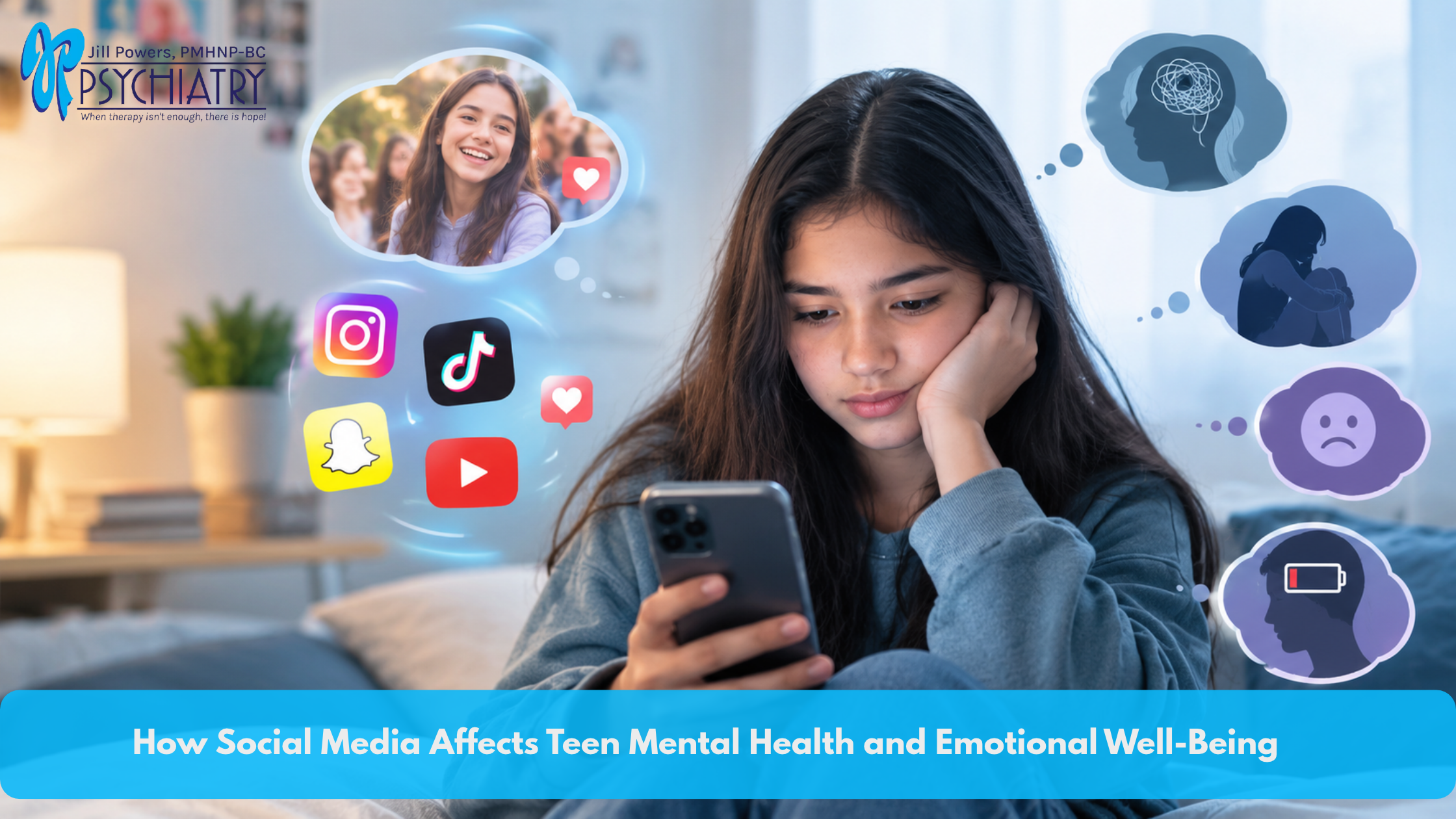



Your teenager used to come out of their room laughing at something on their phone. Lately, the mood shifts faster, the phone comes everywhere, and even small disagreements about screen time turn into bigger arguments. If that sounds familiar, you're not imagining it. Social media can influence teen mental health in different ways, affecting emotions, self-esteem, sleep, relationships, and daily behavior. Understanding that role is the first step toward helping your teen build a healthier relationship with their phone.
Teenage brains are still developing the systems responsible for regulating emotion and impulse control, which makes teens especially sensitive to social feedback. A like, a comment, or being left out of a group chat can register more intensely for a teen than it would for an adult.
Constant comparison is part of that sensitivity. Scrolling through curated photos of other people's appearance, achievements, or friendships can quietly shape how a teen feels about their own life, even when they know the content isn't the full picture.
The fear of missing out adds another layer. Many teens feel pressure to stay constantly connected, checking notifications repeatedly and feeling uneasy about disconnecting, even during family time or before bed.
That pressure often follows them into sleep. Late-night scrolling and notifications can interrupt rest, and inadequate sleep is closely tied to mood, attention, and emotional regulation, which means a sleep problem can look like a mood problem.
None of this means social media is inherently harmful. For many teens, it's also where friendships are maintained and support is found. The effects tend to depend on how it's used, and how much room is left for offline life.
Parents are often the first to notice when something has shifted, even before a teen can put it into words. Some patterns are worth paying closer attention to:
One or two of these on their own aren't necessarily cause for alarm. It's the pattern, several signs appearing together and persisting over time, that's worth paying attention to.
Many parents describe what they're seeing as social media addiction. It's an understandable way to put it, though clinicians tend to look at the specific pattern of behavior rather than assuming a diagnosis from heavy use alone.
That pattern often looks like: checking platforms repeatedly without meaning to, difficulty stopping even when they want to, visible distress when access is limited, losing track of time while scrolling, and returning to the same apps despite recognizing they don't feel good afterward.
There's also no single number of hours that determines whether use has become a concern. It matters more whether social media is interfering with sleep, pulling focus from schoolwork, replacing in-person time with friends, or causing frequent conflict at home. When a teen seems unable to control their own use, even after agreeing to cut back, that difficulty is often the clearest signal worth addressing directly.
Conversation works better than immediate restriction. Asking what platforms your teen uses, why they enjoy them, and how certain content makes them feel opens the door to understanding rather than confrontation. Assuming every app or account is harmful tends to shut that conversation down before it starts.
Once that conversation is open, practical boundaries tend to land better. A few that consistently help:
Boundaries matter, but so does what your teen is actually seeing. Cyberbullying, appearance-focused content, harmful challenges, and ongoing peer conflict tend to affect teens more than time spent scrolling alone.
Teens also notice what the adults around them do. Parents who follow similar boundaries, putting phones away at meals or during family time, make those same expectations easier for a teen to accept.
Sometimes social media intensifies or brings attention to a concern that was already there, rather than being the sole cause of it. If mood changes, anxiety, or sleep problems persist even after healthier boundaries are in place, it may be worth looking at what else could be contributing.
Persistent symptoms can sometimes point to anxiety, depression, ADHD, or an ongoing sleep-related difficulty. Social media behavior alone isn't enough to diagnose any of these, but it can be a useful signal that a closer look is warranted, particularly since screen time above four hours a day is associated with roughly double the rate of anxiety and depression symptoms in teens.
A professional evaluation is worth considering when changes persist despite better digital habits, affect school performance or sleep, interfere with friendships or family life, or lead to a level of withdrawal that feels different from your teen's usual personality. Trusting that instinct, the sense that something feels different, is often the most reliable signal a parent has.
The goal is to understand whether social media habits are supporting or affecting your teen's mental health and emotional well-being. It's understanding whether their digital habits are contributing to broader emotional or behavioral changes, and responding with the right mix of conversation, boundaries, and support. Many teens navigate social media without it becoming a lasting concern, and the ones who need extra support benefit most from parents who noticed early.
JP Psychiatry provides child and adolescent psychiatric evaluations and medication management for children over age 6 and teens, with in-person visits in Chicago and telepsychiatry across Illinois.
Request an appointment if you'd like support figuring out what's going on with your teen.
Younger and mid-adolescent teens tend to be more affected, since identity, self-esteem, and peer relationships are still actively developing during those years. Vulnerability varies by individual, though, not just by age.
Many parents choose some level of monitoring, especially for younger teens, while balancing it with ongoing conversation and appropriate privacy as a teen gets older. What works best often depends on your teen's age and history.
For some teens, a structured break can improve sleep, mood, and focus, especially if use has become compulsive. For others, gradual boundary changes are more sustainable than an abrupt break.
Cyberbullying can feel harder to escape, since it often continues outside school hours and can involve a wider audience, which may intensify feelings of anxiety, shame, or isolation.
Yes. For many teens, social media supports friendships, creative expression, and a sense of community, particularly when it's used actively rather than passively.